
 The Techno Sparks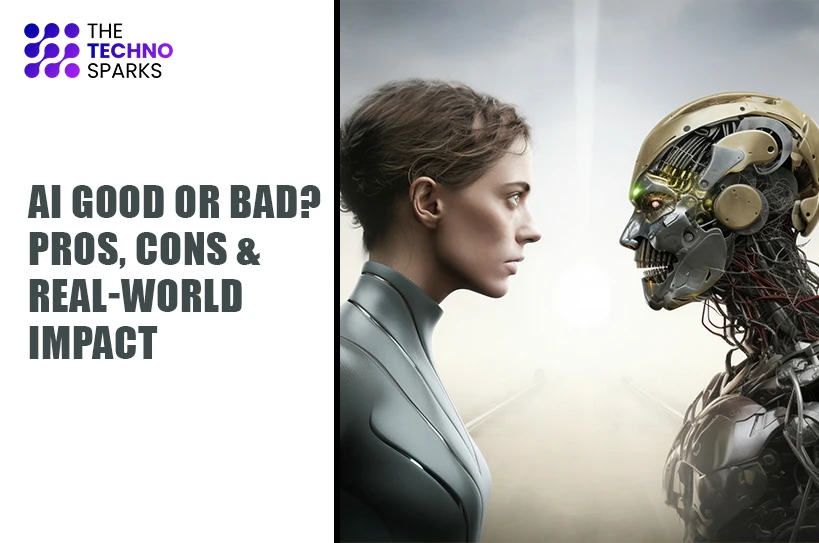
AI Good or Bad? Know how AI supports healthcare, finance, and education while raising safety concerns. Read the full pros and cons analysis by The Techno Sparks. People often ask if “AI good or bad” is even the right question. This tech already helps doctors and teachers, and it gives small creators new tools. It also spreads fake videos and makes many workers nervous about jobs.
The generative AI market is already worth tens of billions of dollars. Some reports say it could cross one trillion dollars by 2034. This shows how fast use is growing.
At the same time, reports warn about bias and loss of privacy, plus heavy energy use that may double data centre power needs by 2030.
So is AI good or bad for society? The honest answer is that it is both helpful and risky. The result depends on how we build and use it.
What Is Artificial Intelligence? A Simple Explanation
People who ask “What Is Artificial Intelligence” usually mean software that can do tasks that once needed human thinking. Many big tech companies describe AI as tools that help computers learn and make hard choices on their own.
These tools can understand speech or spot patterns in data or give useful suggestions. Everyday AI shows up in spam filters and in recommenders inside video apps. Newer systems can also write text or create images on demand.
Every system uses data and rules to guess the next best step. AI does not think like a human mind, yet it can copy some human skills at a very large scale and at high speed.
Why People Think AI Is Good: Key Benefits
People who support AI often talk about clear benefits of artificial intelligence. In healthcare, AI helps spot disease patterns and design treatment plans. It also answers simple patient questions so doctors get more time for complex cases. In daily life, AI keeps spam out of inboxes and helps map apps find shorter routes.
Many chat tools use AI to explain ideas in plain language. Companies rely on AI to forecast demand and cut waste in supply chains. Analysts expect global IT spending linked to AI to help push total tech budgets beyond 5.4 trillion dollars in 2025. That number shows how central AI has already become in the tech world.
Why People Think AI Is Bad: Major Risks & Concerns
People who criticise AI look at both its benefits and its risks, not just the bright side. They worry about job loss and biased algorithms. Deepfake videos and privacy abuse also sit high on their list, along with new kinds of cyber attack.
Many researchers and civil groups warn that weapon based AI and fully autonomous weapons may lower the barrier to war and make errors deadly. Environmental experts add another warning.
Environmental experts add another warning. Large AI models use a lot of electricity and water, and could more than double global data centre power use by 2030 if growth continues without limits. These risks explain the growing demand for strong rules and guardrails.
Is AI Good or Bad? A Complete Breakdown of Benefits & Risks
Instead of picking one label, it helps to see where AI clearly helps and where it clearly hurts. This view makes the “AI good or bad” question easier to handle.
How AI Helps People And Businesses
1. Higher Productivity And Less Repetitive Work
AI handles repetitive, rules based tasks very well. In offices it can summarise emails and fill simple templates. It can also answer common questions that appear again and again. In hospitals it can prepare draft notes or treatment summaries, so clinicians spend more time with patients and less time on paperwork.
For a small team this can feel like an extra helper that never gets tired. The risk is that managers may chase constant speed gains and push staff too hard. Human led use still matters.
2. Better Decisions Through Data
Modern AI tools can scan huge data sets and pull out patterns that humans might miss. In healthcare they analyse scans and lab results. They also read clinical notes to suggest likely diagnoses or flag patients at high risk.
In finance and logistics, similar systems forecast demand and spot unusual transactions that may signal fraud. When humans stay in the loop and treat AI as a second opinion, the mix can improve both quality and speed.
3. New Tools For Science And Medicine
AI can speed up research work. It helps scientists search large bodies of papers and design better experiments. In drug discovery, models can scan many possible molecules and suggest promising compounds much faster than older methods.
One recent example used an AI enabled stethoscope that spotted serious heart problems such as heart failure or valve disease within seconds. Doctors then used that signal to guide earlier treatment after their own checks. Tools like this show how the benefits of artificial intelligence can feel very real when humans use them with care.
4. Support For Creativity And Learning
Generative AI tools help people write and sketch ideas. A designer can try many layout options quickly. A student can ask for a simple explanation of a physics rule. For many users, AI feels like a patient tutor or a friendly brainstorming partner. The biggest gain here is access.
People in small towns or tight budgets can now tap help that once lived only inside top schools or large companies. The downside is that easy content creation also fills the web with low quality text and images, so users need sharp critical thinking.
5. Inclusion, Accessibility And Language Help
AI based captions and translation tools help people who are deaf. They also help readers who use one language but need content in another. Screen readers with AI support can describe images more clearly. Voice assistants help older users and people with mobility issues control phones or laptops.
When design teams do this well, these features cut barriers for many groups at the same time. They also open new job options for people who once struggled to reach training or remote work because tools were not inclusive.
How AI Can Hurt People And Systems
1. Job Disruption And Inequality
Work sits at the centre of many “is AI good or bad” debates. AI will not erase every job, yet it can change daily tasks in many roles. Routine office work and simple customer support already feel pressure. Some coding tasks also move to AI tools. If companies use AI mainly to cut staff and skip training, inequality can rise fast.
People with strong digital skills and money may gain more, while others face fragile incomes. Leaders in government and business will need clear plans for reskilling and safety nets, not just vague promises.
2. Bias And Unfair Decisions
AI learns patterns by looking at data. If that data carries old human bias, the model can repeat and even amplify it. Reports already show algorithmic bias in facial recognition and hiring filters. Some healthcare tools also show this pattern. This can mean a loan model rejects more applications in one neighbourhood than another even when incomes match.
A hiring tool may also downgrade certain names. Fixing this problem needs careful data design, open testing and rules that allow external audits, not just talk about fairness.
3. Misinformation, Deepfakes And Social Harm
Generative AI makes it cheap to create fake images and audio. It can also produce video that looks real at first glance. Deepfake clips can twist the actions of a public figure or a private person and then spread quickly on social media. This can damage reputations and trick voters. It can also support scams.
AI chat tools can generate false but confident text, which some people share without checks. Dealing with this problem will need better detection tools and clear labels. Media literacy and strong laws for harmful use will also matter.
4. Privacy, Surveillance And Data Leaks
Many AI systems train on huge pools of user data such as clicks and messages. Some also use location histories. Without clear limits, this can lead to intrusive profiling. Governments and companies may track people very closely and make decisions they cannot easily question. There is also a clear risk of leaks.
If an AI service stores sensitive prompts or documents and then gets hacked, many users can suffer at the same time. Stronger privacy rules and data limits can lower this risk. On device models help as well, yet people still need to stay careful about what they share.
5. Safety, Security And Environmental Impact
AI already helps control factories, power grids and vehicles. If these systems fail or get attacked, damage can be large. Weapon based AI, especially autonomous weapons that select and fire at targets, raises deep ethical and safety questions that the world has not solved yet.
Training and running large AI models also uses heavy electricity and water in data centres. The International Energy Agency warns that AI could more than double data centre power demand by 2030.
That level would exceed the current use of some entire countries. Cleaner energy and more efficient models will be vital if we want AI growth without huge environmental strain. Clear reports on energy use will also help people see the real impact.
FAQs
Is AI good or bad for society?
AI does both, as benefits and risks of AI run simultaneously. It can improve healthcare and transport and make information easier to reach. It can also add job stress, spread deepfakes and hurt privacy. Clear laws, safety rules and good public education help tilt things to the good side.
What are the biggest benefits of artificial intelligence?
The main benefits of artificial intelligence include higher productivity, better data driven decisions, new tools for science and healthcare and wider access to learning and creative help. Doctors can diagnose faster, logistics teams can reduce waste and students can ask questions in plain language. These gains appear when AI supports human work instead of trying to replace it completely.
What are the main dangers or risks of AI?
Big risks include biased decisions, job loss, deepfakes, privacy leaks and cyber attacks. The danger comes both from the tools and from how people use them. Strong rules, clear responsibility and outside checks can lower harm, but they need real effort.
Can AI replace human intelligence completely?
Today’s systems beat people at narrow tasks like chess or pattern spotting. They still miss common sense, rich emotion and wide life experience. Many experts think general intelligence, if it comes, will still have limits. For now, AI works best as a helper, not a full swap.
Is AI safe to use in daily life?
Most simple uses like spam filters or maps are fairly safe. Problems grow when you share private data, trust AI alone for health or legal choices or believe every AI image or message. Stay safer by checking facts, sharing less data and staying alert to scams.
Must Read:
- software companies in madhapur
- how to register in cowin app
- how to uninstall apps in ubuntu
- how to add beneficiary in sbi yono app
- how to use tez app
